
Independent of the Organization, Not Independent of the Problems
“Scientology Without the Weird Pressure”
In 2023, I received a flyer that would be the beginning of a spiritual journey.
The flier introduced an idea to me — the idea of independent Scientology.
The flier itself said that it was an “independent Scientology center” that provided the good parts of Scientology without the “pressure” or coercion.
It was critical of the Church of Scientology but maintained the position that there is good within Scientology.
This fascinated me.
Of course, I had heard of the Church of Scientology. I had never heard of independent Scientology. The idea that you could practice the “good parts” of a system outside of an abusive institution was and still is in many ways revolutionary to me.
Unfortunately, it is partially a lie.
Catching Belief
In 2024 I began my podcast called Catching Belief. In many ways it was a response to being frustrated or otherwise disillusioned with the way that cults were treated within the context of the media.
I wanted to genuinely explore the perspectives of people who had left a cult but retained some of the ideas. I wanted to know what the “kernels of truth” were within people that made them stay in the groups they were initially in. So, I started the podcast and the first person I interviewed was the “course supervisor” of the center whose flier I received in the mail. I wasn’t considering independent Scientology as a personal venture of my own outside of looking at it from a religious studies angle but not long after the interview, I did.
I came away from this interview with a general understanding: that the Church Scientology as an organization was abusive but that within independent Scientology was an opportunity to practice Scientology without the abuse. If you walked away from the organization and practiced outside the organization, you were basically fine.
The truth is more complex.
Orthodox Independent Scientologists and Progressive Independent Scientologists
From the get go, I did see potential issues with the independent Scientology supervisor I interviewed.
One, the supervisor believed in aspects of L. Ron Hubbard’s character that I found problematic. Two, the supervisor implied that if an individual was to undergo auditing (the primary practice of Scientology) with her organization that an individual could not do therapy or psychiatry alongside Scientology. She believed that if a person wanted to stay within her group, they’d have to “make a decision” about whether staying in therapy or on psychiatric medicine meant more to them than Scientology.
So, I didn’t choose to practice alongside her. If I had to make that decision, her center wouldn’t work for me.
For those who do not know, independent Scientology is a category for a variety of movements just as much as Protestantism is to Christianity. It is a blanket categorization for a large number of different movements and practitioners who have widely varying perspectives on how Scientology should be practiced as a whole. It isn’t uncommon for independent Scientologists to have disagreements with other independent Scientologists. I saw this as and still do see it as a good sign.
Since independent Scientology is more of a categorization than it is a distinct orthodoxy, I have noticed a general spectrum of practice.
This spectrum hinges on if the practices can be “altered”, which means changed in one way or another from how L. Ron Hubbard and the people around him organized and solidified it.
On one end are the “orthodox independent Scientologists.” These are Scientologists who essentially believe Scientology should be practiced exactly as it is as written by Hubbard with some exceptions. These exceptions vary from practitioner to practitioner. A funny term I learned by my independent Scientology trainer to describe “orthodox independent Scientologists” was “Hubbard Scientologists.” I don’t think this is inaccurate. These “Hubbard Scientologists” believe Hubbard’s teachings are completely infallible and cannot be scrutinized or questioned.
On the other end are (for lack of a better word) “progressive independent Scientologists.” These are Scientologists who believe that Scientology can be “innovated” beyond Hubbard’s orthodoxy. The people I ended up practicing with and still do practice with fall on the end of being progressive independent Scientologists.
The initial course supervisor from the center I interviewed sat somewhere on the end of “orthodox independent Scientologist.” The reason I didn’t want to practice with her was she because was replicating real time problems that the Church has within her own practice.
What is that partially the result of?
Leaving the Organization is Not Enough
While leaving the organization is step one, it is not enough.
If we want to cultivate a safer self help industry, and I do believe independent Scientology is a part of the self help industry, we have to question not just the organization but the ideas. If we don't, we are prone to fall into patterns of similar relationships or dynamics from the abusive organizations or individuals we separated from.
Exemption from Abuse is not Exemption from Side-Effects
I have had and continue to have amazing experiences with the independent Scientologists I’ve practiced alongside and trained with. When I raised concerns or questions in the past, they were taken seriously. I was treated with dignity, individuality and authenticity.
Despite this, I have had side-effects from some of the ideas or processes I was taught.
I recently realized something crucial. Just because you are not or no longer experiencing abuse from a group or guru does not mean you are exempt from the negative or unexpected side-effects from a self-help distinction, religious practice or idea. You can have wonderful experiences and still be impacted by the tools in ways you did not expect.
Why is this?
Even the “Good Parts” Can Be Complicated or Harmful
These self help distinctions, religious practices or ideas are complicated. They are helpful in certain situations and detrimental in others. It’s possible a tool that seems empowering in one scenario may have a component to it that is disempowering in another context.
The “good” we want to practice away from an abusive organization, guru or group may be more complicated than we initially thought. Sometimes what we were told was just flat out wrong. If we really want to practice the “good” away from the organization, we have to understand the complexity of the “good” or if that good even is good.
Meditation and mindfulness, for instance, is very helpful for many people. It can help people calm their mind, reduce stress and cultivate self awareness over their own thoughts or emotions. On the other hand, meditation in various situations can actually worsen intense anxiety, ongoing depression, trauma, psychotic episodes or substance abuse issues. There have been groups where meditation is used as a “cure-all” and viewed as a universally helpful method of self improvement. The issue with a claim like that is it’s simply not true. The truth about meditation and its efficacy is complicated, just like these “good parts” we may have practiced inside an organization or continue to practice outside of.
How Can We Do Better?
One of my favorite things about SEEK Safely and iLumn8 is their focus on roads forward.
I have shared the SEEK Safely Practioner Promise and Be a Safe Seeker red flags and green flags to three independent Scientologists close to me. All three loved the resources they received. There are, unfortunately, predators and predatory organizations in the independent Scientology field just as much as there is within the self help field.
Outlining what is genuinely unethical behavior compared to ethical behavior creates a standard practitioners and consumers can begin to set.
Three components of the SEEK Safely Practitioner Promise that I believe independent Scientologists could use to minimize issues that arise during the practice of independent Scientology away from the Church of Scientology is the following:
Accurate: It will clearly delineate what is personal opinion, belief or speculation as opposed to information that is supported by third party research.
Respectful: Participants will be able to freely express opinions without fear of public humiliation, ridicule, shame or physical abuse.
Safe: The leader will have a comprehensive risk management plan to minimize any risk taken by the participants.
We can begin to do better by an honest and genuine analysis of what in our practices may have problematic behaviors, ideas or side-effects. After that, we need to implement new ways of being based on this inquiry and maintain a standard that prioritizes practitioners and consumers.
I have been able to enjoy my experiences with tools and practices far more by understanding the limits of those practices rather than believing it will simply do things that it won’t.
Conclusion
With all of that in mind… leaving the organization is not enough. The ideas we held while in an abusive situation are oftentimes a part of the problem. We have to question, learn from and move beyond the organization, guru or ideology we left rather than replicate the failures of that system.
~ JUNE SMITH, Contributing Author
June Smith is a podcast host and producer for the Catching Belief podcast.
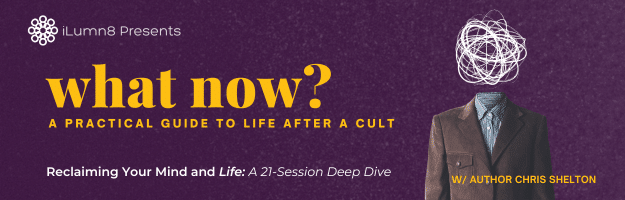
Reclaim Your Life
Have you — or someone you love — escaped a high-control group, an abusive relationship, or a destructive cult? What Now? by Chris Shelton is one of the most practical, compassionate roadmaps ever written for navigating post-cult recovery. And now, you can go through it chapter by chapter, live, with the author himself.
Open door ... join the group ANYTIME and you get access to ALL recordings and materials.